1. Understanding an ACL Injury
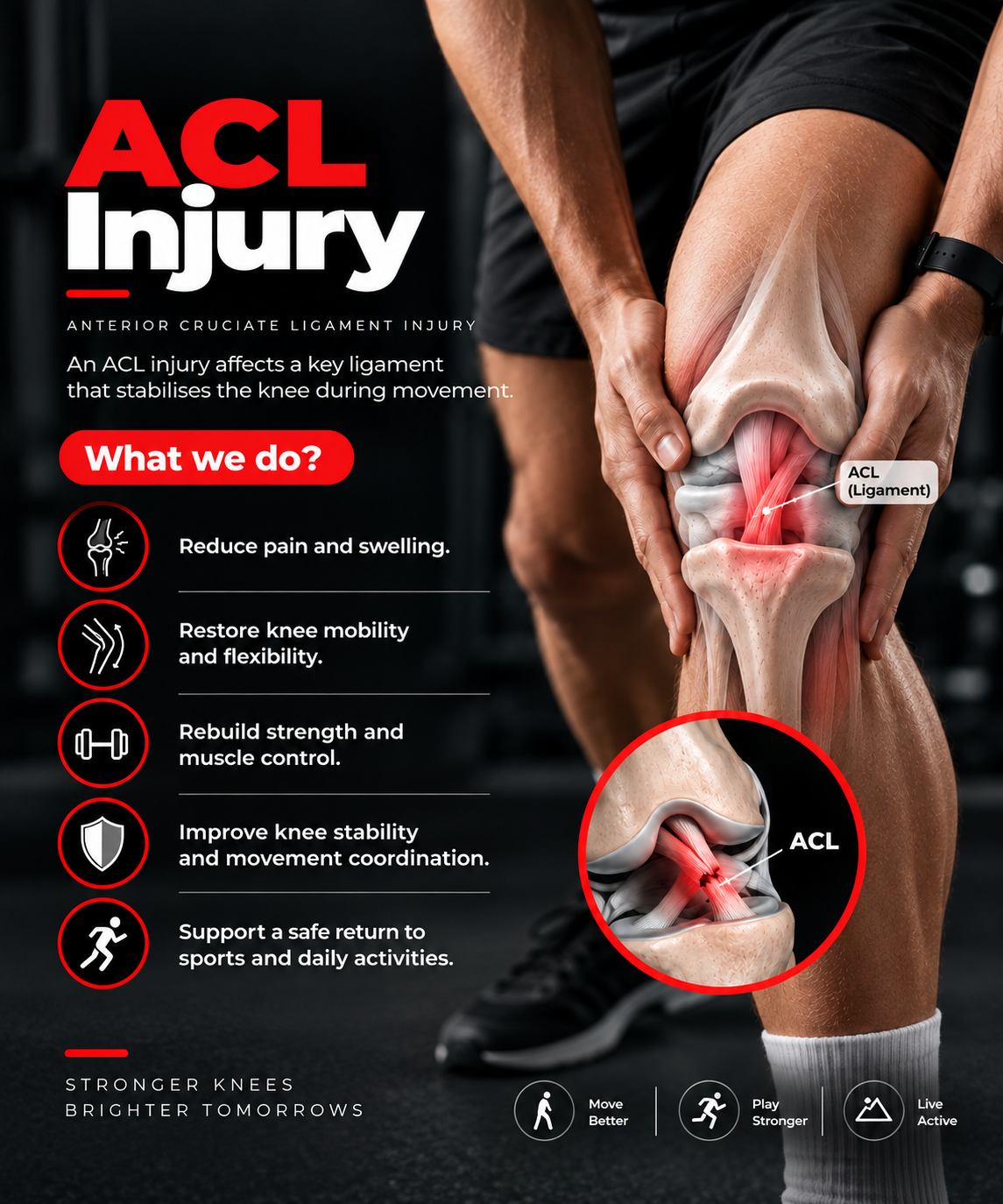
The anterior cruciate ligament is one of the major ligaments inside the knee. It helps control the movement of the shinbone relative to the thighbone and contributes to rotational stability during dynamic activities.
ACL injuries commonly occur during sports involving sudden deceleration, cutting, pivoting, landing, or rapid changes in direction. They can also occur following direct contact or accidents.
Sports such as football, basketball, handball, kabaddi, badminton, and skiing can place considerable demands on the knee.
Common symptoms following an acute ACL injury may include:
- A popping sensation at the time of injury.
- Rapid swelling around the knee.
- Pain and difficulty bearing weight.
- Reduced knee movement.
- A feeling of instability or the knee giving way.
However, symptoms vary, and they cannot confirm an ACL tear on their own. A clinical assessment by an appropriately qualified healthcare professional is important when an ACL injury is suspected.
Treatment depends on several factors, including the extent of the injury, associated meniscus or cartilage damage, knee stability, activity level, sporting goals, and personal preferences.
Not every ACL injury automatically requires surgery. Some people may be appropriate candidates for structured non-operative rehabilitation, while others, particularly those with instability who wish to return to demanding pivoting sports, may benefit from surgical reconstruction. These decisions should be made with the treating orthopaedic specialist.
Regardless of the chosen treatment pathway, rehabilitation plays a central role in restoring physical function.
4. Why Being Pain-Free Does Not Mean You Are Ready to Play
One of the most important principles in modern ACL rehabilitation is that symptoms alone cannot determine readiness.
An athlete may have little or no pain during daily activities while still having substantial deficits in strength, power, movement control, or sport-specific conditioning.
For example, an athlete may be able to walk, climb stairs, and cycle comfortably but struggle to produce force during a single-leg jump.
Another athlete may complete a planned change-of-direction drill but lose movement control when asked to react to an unexpected cue.
These differences are important because competitive sport is fast, unpredictable, and physically demanding.
Pain remains an important symptom to monitor, but a lack of pain does not automatically indicate that the knee is ready for unrestricted sport.
Clinicians should consider a broader set of measures, including:
- Knee range of motion and swelling.
- Clinical assessment of knee stability.
- Quadriceps and hamstring strength.
- Jumping, landing, and hopping performance.
- Movement quality and control.
- Running and change-of-direction capacity.
- Psychological readiness and confidence.
- Tolerance of progressive sport-specific training.
The specific tests and thresholds should be selected according to the athlete, the sport, the stage of recovery, and the clinical context.
5. Return-to-Sport Testing: Moving Beyond Guesswork
How can a physiotherapist assess whether an athlete is ready to progress towards competitive sport?
A structured return-to-sport assessment helps bring together information about physical capacity, function, symptoms, confidence, and the demands of the intended activity.
Strength testing
Quadriceps and hamstring strength are important components of assessment.
Where available and appropriate, objective testing tools can measure force production more accurately than visual observation alone. Other clinical strength assessments can also provide useful information.
Comparing the injured and uninjured limbs can help identify asymmetry. However, limb symmetry should not be interpreted in isolation. If both legs have become weaker during rehabilitation, a similar result between limbs may hide a deficit in overall capacity.
Pre-injury data, body-weight-relative strength, and sport-specific demands can provide additional context when available.
Functional performance tests
Depending on the individual's goals, testing may include single-leg hop variations, jump performance, balance tasks, landing assessments, and change-of-direction activities.
These tests help clinicians evaluate how an athlete produces and absorbs force.
However, passing one test does not guarantee readiness for every sporting situation. Test results must be interpreted alongside clinical findings and the demands of the athlete's sport.
Movement quality
Two athletes may achieve similar jumping distances but demonstrate different landing strategies.
A comprehensive assessment considers movement control, coordination, and the ability to manage force under increasing demands. Video analysis or specialised equipment may help when available, but useful clinical observations can also be made without advanced technology.
Psychological readiness
Confidence matters.
An athlete may demonstrate good physical progress but hesitate when asked to jump, cut, or participate in team training because of fear of reinjury.
That concern should not be dismissed as a lack of motivation. It can be addressed through education, realistic goal-setting, and progressive exposure to increasingly challenging activities.
The aim is to help athletes rebuild trust in their bodies while respecting their current physical capacity.
No single test, score, or time point can guarantee that reinjury will not occur. Return-to-sport decisions should combine multiple sources of information and involve the relevant healthcare professionals and the athlete.
7. Common ACL Rehabilitation Mistakes to Avoid
Mistake 1: Rushing back because the knee feels normal
Everyday comfort does not necessarily indicate adequate strength, power, or movement control for sport.
Progress should be based on clinical assessment and relevant functional milestones.
Mistake 2: Focusing only on the injured leg
The uninjured leg can also lose strength and conditioning during a prolonged period of reduced activity.
A well-designed programme considers the whole athlete and develops the physical qualities needed for performance.
Mistake 3: Avoiding challenging exercises for too long
Rehabilitation needs to progress. Remaining indefinitely at an easy exercise level may not prepare the athlete for high-force sporting activities.
The solution is not to increase difficulty recklessly, but to introduce appropriate loading as capacity improves.
Mistake 4: Ignoring landing and change-of-direction mechanics
Running in a straight line does not replicate every demand of football, basketball, or badminton.
Athletes need progressive exposure to jumping, landing, deceleration, and directional changes relevant to their sport.
Mistake 5: Treating confidence as an afterthought
Physical recovery and psychological readiness may progress at different rates.
Gradual exposure to sport-specific movements can help athletes develop confidence without forcing them into activities they are not ready to perform.
Mistake 6: Stopping rehabilitation after returning to training
Returning to training is a milestone, not necessarily the end of the rehabilitation journey.
The athlete may still need to develop match fitness, repeated-effort capacity, explosive power, and the ability to tolerate a full training schedule.
Continued monitoring and progressive workload management remain important as training demands increase.
9. ACL Rehabilitation at Centre of Movement Medicine
At Centre of Movement Medicine, we believe rehabilitation should be individualised, progressive, and focused on meaningful outcomes.
Our approach to sports injury rehabilitation is built around understanding the patient's goals, assessing their current capacity, and developing a structured plan to address the limitations identified during assessment.
For an individual recovering from an ACL injury, this may involve different priorities at different stages.
Early in recovery, the focus may be on restoring movement and rebuilding basic muscle activation. Later, the programme may progress towards strength development, single-leg control, running, jumping, agility, and sport-specific training.
We also recognise that recovery is not purely physical. Education, confidence, realistic expectations, and communication with the treating orthopaedic specialist can all contribute to a more informed rehabilitation journey.
Our aim is to help patients progress beyond basic daily function and work towards the activities that matter to them, whether that means returning to recreational exercise, gym training, or competitive sport.
If you are looking for ACL rehabilitation in Gurgaon or ACL physiotherapy in Delhi, a personalised clinical assessment can help determine your current stage of recovery and the next appropriate steps.
Every patient is different. Rehabilitation should reflect your injury, treatment, goals, and progress rather than following a one-size-fits-all protocol.
10. Frequently Asked Questions About ACL Rehabilitation
Can I return to sport once my ACL surgery has healed?
Surgical healing is only one part of recovery. Returning to sport also requires adequate strength, functional capacity, movement control, psychological readiness, and progressive exposure to sport-specific activities. Clearance should be based on a comprehensive assessment.
Is ACL surgery always necessary?
No. Selected individuals may be managed with structured non-operative rehabilitation. The appropriate approach depends on knee stability, associated injuries, activity goals, and clinical assessment. Discuss your options with an orthopaedic specialist.
When can I start running after ACL reconstruction?
There is no single date suitable for everyone. Running progression should consider symptoms, knee movement, swelling, strength, impact tolerance, surgical precautions, and functional readiness. Your rehabilitation team can help determine when and how to progress.
Are strengthening exercises enough for ACL rehabilitation?
Strength is essential, but it is not the only requirement. Depending on your goals, rehabilitation may also need to address balance, coordination, jumping, landing, deceleration, agility, conditioning, and sport-specific skills.
Can I injure my ACL again after reconstruction?
Yes. ACL reconstruction does not eliminate the possibility of another ACL injury. Appropriate rehabilitation, adequate recovery time, functional assessment, and injury-prevention training can help manage risk, although no approach guarantees prevention.
How do I choose an ACL physiotherapist?
Look for a qualified professional who performs an individual assessment, explains the rehabilitation plan, progressively develops strength and function, monitors your response to loading, and considers your specific sporting goals. Communication with your orthopaedic team is also important when relevant.
Conclusion: Recovery Is About Building Capacity, Not Watching the Calendar
An ACL injury can be a challenging experience, but rehabilitation provides a structured pathway towards rebuilding movement, strength, and confidence.
The most important lesson is that being pain-free, walking comfortably, or reaching a particular month after surgery does not automatically mean you are ready for competitive sport.
Successful rehabilitation requires progressive loading, objective assessment, sport-specific preparation, and attention to both physical and psychological readiness.
At Centre of Movement Medicine, we believe the goal should extend beyond simply getting back on your feet. It should be about developing the capacity to move confidently and meet the demands of the activities you value.
Recover with purpose. Come back ready.
If you are recovering from an ACL injury or planning your return to sport, contact Centre of Movement Medicine to discuss a personalised sports rehabilitation assessment in Gurgaon or Delhi.
Medical disclaimer: This article is for educational purposes and does not replace an individual medical assessment. Rehabilitation exercises, timelines, and return-to-sport decisions should be tailored to the patient's condition and coordinated with the treating healthcare team where appropriate.
References and Further Reading
- Aspetar Clinical Practice Guideline on Rehabilitation After Anterior Cruciate Ligament Reconstruction. British Journal of Sports Medicine. Read the guideline
- American Orthopaedic Society for Sports Medicine. Return to Play After ACL Reconstruction: Integrating Key Metrics. Read the article
- Asia-Pacific Knee, Arthroscopy, Arthroplasty and Sports Medicine Society. Consensus Statement on Return to Play After ACL Reconstruction. Read the consensus statement
- European Society of Sports Traumatology, Knee Surgery and Arthroscopy. EU-US ACL Rehabilitation Consensus Initiative, 2026. Read the update